Getting started with the collection:
No image available
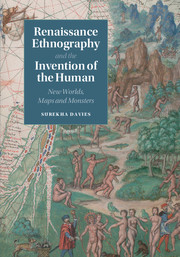
Renaissance ethnography and the invention of the human: new worlds, maps and monsters
By
Abstract
"Giants, cannibals and other monsters were a regular feature of Renaissance illustrated maps, inhabiting the Americas alongside other indigenous peoples. In a new approach to views of distant peoples, Surekha Davies analyzes this archive alongside prints, costume books and geographical writing. Using sources from Iberia, France, the German lands, the Low Countries, Italy and England, Davies argues that mapmakers and viewers saw these maps as careful syntheses that enabled viewers to compare different peoples. In an age when scholars, missionaries, native peoples and colonial officials debated whether New World inhabitants could - or should - be converted or enslaved, maps were uniquely suited for assessing the impact of environment on bodies and temperaments. Through innovative interdisciplinary methods connecting the European Renaissance to the Atlantic world, Davies uses new sources and questions to explore science as a visual pursuit, revealing how debates about the relationship between humans and monstrous peoples challenged colonial expansion"--
Contents
Introduction: Renaissance maps and the concept of the human -- Climate, culture or kinship? Explaining human diversity c.1500 -- Atlantic empires, map workshops and Renaissance geographical culture -- Spit-roasts, barbecues and the invention of the Brazilian cannibal -- Trade, empires and propaganda: Brazilians on French maps in the age of François I and Henri II -- Monstrous ontology and environmental thinking: Patagonia's giants -- The epistemology of wonder: Amazons, headless men and mapping Guiana -- Civility, idolatry and cities in Mexico and Peru -- New sources, new genres and America's place in the world, 1590-1645 -- Epilogue.
Publisher
Publication
Cambridge: Cambridge University Press, 2016
Year
Is about
Subject
Period
1450-1650
Type
Language
Classification
ISBN
- 9781107036673
- 1107036674
Online resources
Persistent URL
To refer to this object, please use the following persistent URL: